
When choosing a preschool for your child, it can be tough to decide between different types of programs. Let the experiences of three families at three different types of preschools — Preschool for All, private and co-op — help guide your choice.
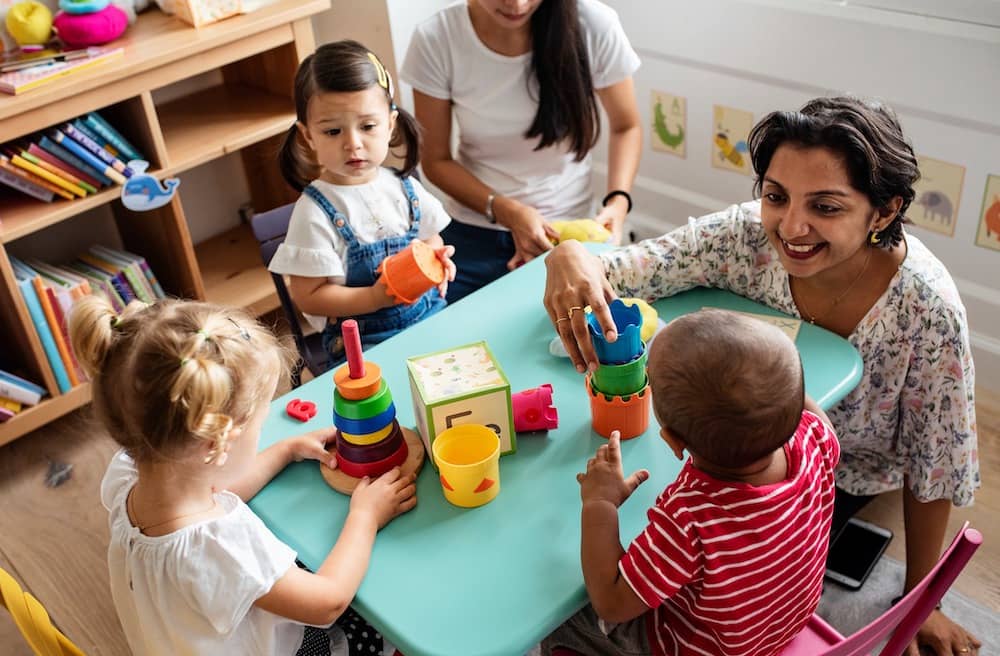
With such a wide variety of preschool options to choose from in the Portland area, and an even wider array of existing FAQs about choosing the best one for your child and family, the best place to go for answers is the source: other parents!
Each of these three families chose a different route for their child — a private preschool, a Preschool for All campus and a co-op style school where parents are expected to pitch in. While each experience was different, all the parents agree on one thing: prioritizing their child’s educational needs and finding a program that fits with their family’s lifestyle are paramount.
The Course to Co-op
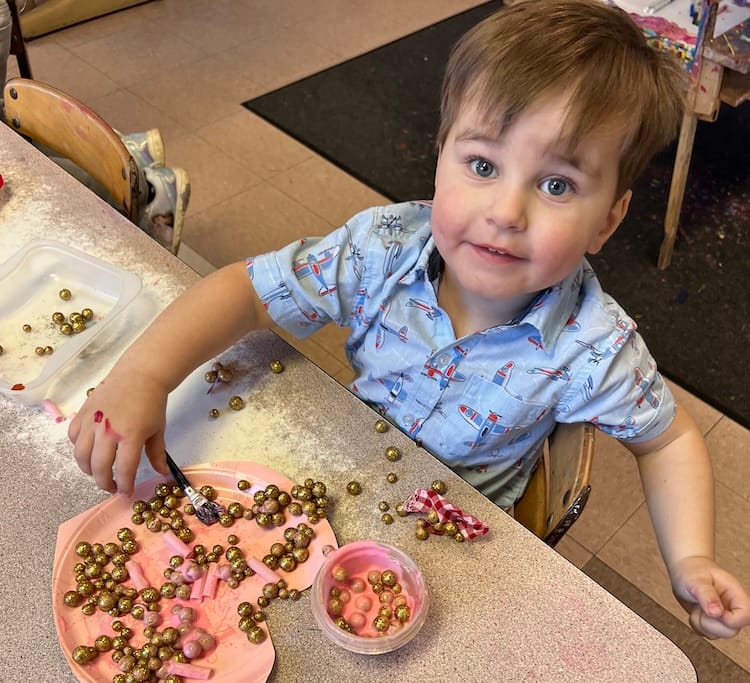
After parenting through COVID, moving to Portland from Beaverton, and realizing that their social community was mostly made up of child-free friends, the biggest priorities for Mer Stevens and Jacquie Carr when it came to finding a preschool were community and connection. “We communicated with a couple of different places,” Stevens says, “but we had those kinds of instant connection conversations with people at Hancock Street Preschool. They just felt like real, human moments.” For this family, those sparks of connection turned into sending two of their children through Hancock Street Preschool’s Co-Op program. Their youngest son, Ignatius (pictured above), has been at Hancock Street for over a year, and transitioned to the 4-year-old group in September 2025. Stevens has even served in various capacities in the school’s leadership, now serving as the board president. Hancock Street Preschool has truly become the village this family was searching for. “Everybody is there with a lot of purpose,” says Stevens.
Every step of the way has been warm and inviting for Stevens and her family. Although there was a formal admissions process (a simple portal application and conversation with Hancock Street), the highlight was an “incredible, wild, loud, fun!” open house. Once the admissions offer was accepted, families got to spend casual time getting to know each other at park playdates and teachers conducted home visits leading up to the first day of school. “A lot of intention went into making connections,” Stevens explains. The goal of all pre-enrollment activities is for potential students to feel like the school belongs to them, and for potential parents to understand the commitment of the co-op experience.
This commitment can pose challenges for families who may have less capacity, and Stevens knows that the co-op model isn’t for everyone. “If you’re not in it for the full experience, the timing can be really challenging!” she says. For some families, the notion of a co-op school in theory — and the excitement of participating in such a vibrant community — can end up clashing with the reality of the uniquely intense time commitment. Families are required to volunteer two days per month in the classroom, along with taking on other external roles, from managing the school’s laundry to helping with various school fundraisers. Generally, the commitment is six to seven hours per month, with some positions having busier seasons and some requiring more consistent involvement throughout the year.
For Stevens and her family, though, the commitment has been worth it. She values the school’s intentions around early literacy, the play-based curriculum, and the conscious decisions teachers make around themed units. The school environment is full of “really cool things for kids to just get their fingers into,” she says, and the building itself includes an outside area with a play structure, tricycles, and a “rock box” (which is exactly what it sounds like). Being able to work side-by-side with the teachers in her son’s classroom on a regular basis is also a valuable experience. “And there’s always an opportunity to explore and go make a mess,” says Stevens.
The Path to Preschool for All
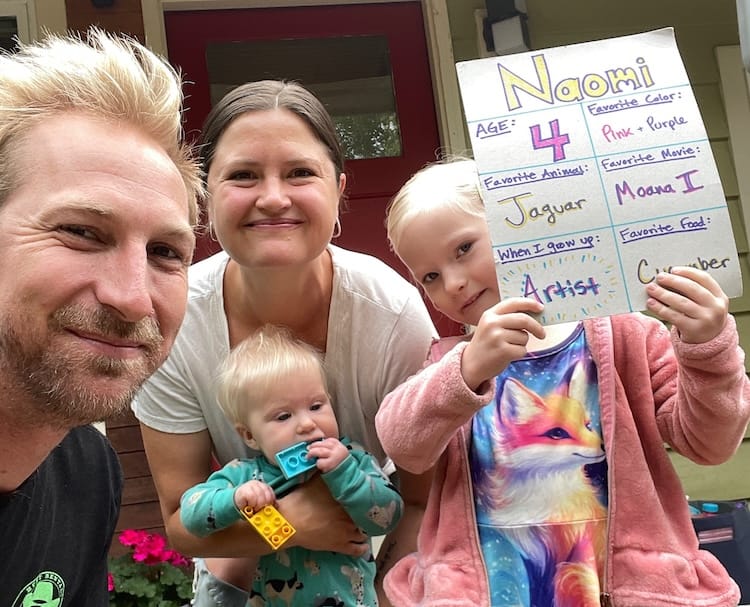
When Preschool for All (PFA) became an option for Ben and MJ Molyneux’s oldest daughter Naomi (pictured above), who is 4 ½, the prospect of the break on their current childcare tuition was a huge draw, but wasn’t their only priority. “Naomi is a sensitive kid, and we wanted her to feel supported,” MJ Molyneux says. As she began to ask around her circle of North Portland mom friends, Montessori House in St. Johns was consistently a top recommendation. Molyneux had been drawn to the Montessori method of education since becoming a mom — and it didn’t hurt that their round-trip from home to school would be less than 10 minutes. After missing the first round of applications, Montessori House added a second preschool classroom and opened more slots, so the Molyneuxs jumped at the chance to apply. Their admissions process was straightforward: a week after completing the PFA application, they received emails both from PFA and Montessori House offering Naomi a seat. “We felt really lucky, we kinda felt like it was magic!”
The first half of the 2025-2026 school year has gone wonderfully for Naomi. Montessori House has a specific flow to each day, moving between different activity stations or “work times,” breaking for snack, lunch and recess, and moving between classrooms in the afternoon to accommodate nap time. For MJ Molyneux, one of the biggest benefits of the Montessori model is that students get to take the lead in choosing which activities they want to focus on. At a recent parent-teacher conference, Naomi’s teacher talked about gently encouraging Naomi to try other activities beyond art; Molyneux laughs recalling the story. “Naomi has a lot of power over how she spends her time,” she explains, “so she has stacks of art to bring home at the end of the week!” This student-led learning and space for Naomi to explore her own interests has been a really special part of Montessori House.
For the Molyneuxs, the only drawback is the larger size of the program — the whole school has four classrooms and about 60 enrolled students. Naomi is a kid who can get overstimulated easily, and her social battery is drained by the end of the week. But MJ sees an upside: While challenging, she predicts that Naomi learning those coping skills now will benefit her in the long run.
Ultimately, the Molyneuxs are pleased with the preschool program. “It feels really important to say that I’m so grateful for Preschool for All and for Montessori House — it’s a really good school, and we are so, so grateful. It has changed our year!”
The Pursuit of Private School
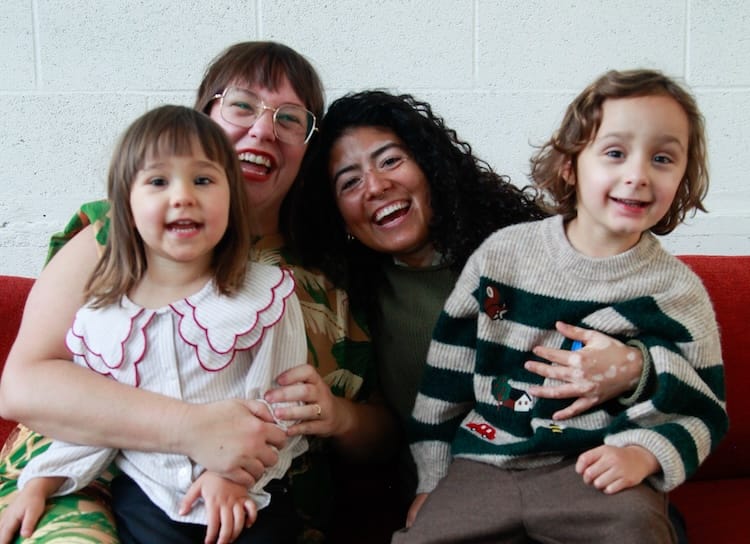
As a bicultural family, the Knowles family (Kelly is from the U.S.; her wife, Tere, is from Panama) prioritized a Spanish-language preschool for their 5-year-old son, Reggie (pictured above far right), who has now been at Mariposas Playschool for two years. Besides the Spanish-language component (students are spoken to in Spanish at least half of every school day), the Knowles family was drawn to Mariposas because of the emphasis on outdoor time — the students have over three hours of outside time every day, in all weather. In addition to the many opportunities for open, self-directed play, “they also have a very keen focus on art,” Kelly Knowles adds. It’s also a bonus that the whole family (their youngest daughter Ramona now also attends) can drive, bike or walk to Mariposas every day.
Admission started with a tour and a meeting with the primary educator before submitting their application, and eventually accepting the school’s offer of enrollment. Mariposas also offers after-care options, which helps offset a major challenge that the Knowles family knew they’d be taking on: the school is primarily open from 9 am to 2 pm, four days a week, a difficult balance for these two working parents to juggle. The Knowles family occasionally takes advantage of the after-care, several times a week, which adds $25 per day on top of the $1,100 monthly tuition.
With costs adding up, the Knowles family looked into Preschool for All for the 2025-2026 school year, and Reggie was offered a mid-year seat at a PFA site near to the family’s home in North Portland. After much back and forth, they ultimately decided to keep him at Mariposas not only for the educational aspects, but also for the strong community of families and the close connections their whole family has with the educators. “We absolutely love this school!” Knowles emphasizes. “It’s been really great for our family, and the educators are wonderful.”
Ultimately, there is no perfect preschool for your child: whether you secure a Preschool for All slot, go the private preschool route, or join a co-op, there will be compromises. Knowing your priorities as a family will help guide your decision and keep the focus on the bigger picture: giving your child a positive preschool experience to launch them into their formal education.