
Get your family prepared for earthquakes and other natural disasters — and calm your own parental anxiety about “The Big One.”
If you’re reading this, you’re already brave. Parents put out proverbial fires every day, so considering a massive earthquake that may or may not happen in our lifetime is a tough ask. But as an active Neighborhood Emergency Team (NET) volunteer and mother to a 3-year-old, I have a secret for you: Preparing your family for an emergency is empowering, kind of fun and might actually reduce anxiety.
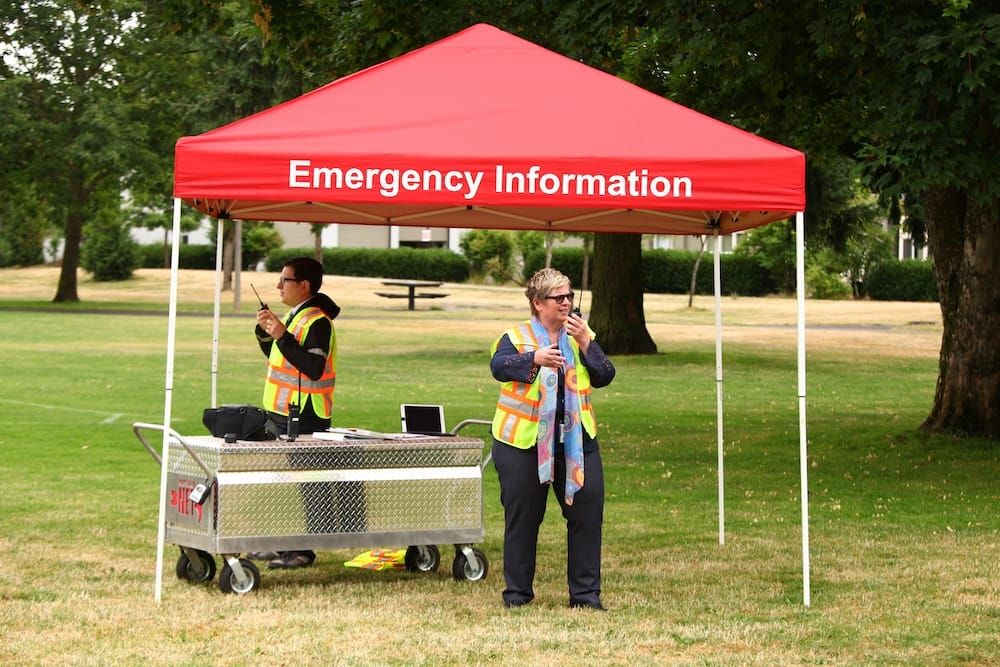
Early in 2025, wanting to fend off post-election blues, I joined my neighborhood emergency team. The NET program provides Portland residents with hands-on emergency response training by Portland Emergency Management Bureau (PBEM) and Portland Fire & Rescue. I recommend it — it’s the first time I ever actually used a fire extinguisher — but you don’t need all 28 hours of basic training to be proactive for your family and start preparing for emergencies at home.
The main emergency we prepare for in Portland is a magnitude 8.0 to 9.5 earthquake in the Cascadia Subduction Zone, just off the coast. Experts say this earthquake is definitely happening. We just don’t know when. Could be tomorrow — or 30 years from now.
If you keep reading, (again, brave as heck!) I’ll share resources I’ve learned from my training and from local experts on how to approach emergency planning with children of any age.
Stay Informed
Laura Hall is a Portland parent with a professional background in emergency management who helped start Parents 4 Preparedness, a parent group of seismic safety advocates who had children in Portland Public Schools (PPS). The group has almost entirely decelerated since the onset of COVID (who wants to discuss a possible earthquake when confronted with an actual pandemic), but the lessons they’ve learned remain relevant.
The first thing Hall says parents should do is to sign up for emergency alerts at PublicAlerts.org. Your phone should get a ShakeAlert when a major earthquake hits if your phone is within range of the epicenter, the way you would an Amber Alert. With PublicAlerts, you sign up to receive a wider range of emergency alerts based on addresses, which Hall says is important if you have a child in a school across town.
You could also download the MyShake app, which in addition to regular alerts, has a button to get a test alert.
However you receive it, the alert warning of shaking is sent within seconds of an earthquake starting at its epicenter. When you get an alert, you may then have a few critical seconds to do what you need to do.
Manage Your Emotions
When you get a ShakeAlert, you’ll need to drop, cover and hold on. Sound familiar? If you haven’t really thought about this drill since your own school days, it’ll probably feel different this time around, now that you’re the adult in the situation.
Hall recommends not dwelling on the worst case scenario. Instead, she says, focus on the most likely scenarios first. I spoke with my preschooler’s teacher about their monthly fire drills, and she told me she doesn’t make it feel real to them — they don’t need that at their age. Honestly, neither do we. The best part about planning for an emergency is taking advantage of the calm, rational mind to determine your best course of action.
Creating a family emergency plan shouldn’t feel traumatizing. When we have exercises in the NET program, we’re asked to consider the reality of the scenarios, but we’re not expected to feel that reality in our bodies as we learn. Manage your own anxieties first and, when you’re ready, involve your children.
At the Oregon Museum of Science and Industry (OMSI), Participatory Research and Evaluation Manager Scott Randol, Ph.D., leads the museum’s ShakeAlert initiative, often speaking directly to families about how to prepare. “The fear of the unknown — not knowing what to do — is scary,” he says. “But actually going through the motions, knowing what to do when it does happen, really brings that anxiety level down. It takes the unknown out of it.”
Make a Plan
Create a family plan for what to do during an earthquake in your home. Together, your family can identify the safest place to take cover in each room of the house, draw a map of your home, and mark the shelter spot for each room.
Check out PublicAlerts.org/get-ready for detailed guides on how to make an emergency plan. Do a “hazard hunt” in your home (FEMA has a great infographic guide on how to do this). Identify the objects that could fall, anchor furniture, and learn how and when to shut off utilities.
Next, plan for what happens after the shaking stops. This should include an escape plan. That map of your house? You can also mark escape routes from each room. If you have an upper floor, consider how you’ll exit if your stairs collapse, or if a fire breaks out downstairs.
Once you’re out of the house, you’ll need an established meeting place. You’ll want one outside your home and one outside your neighborhood in case you can’t get home.
Discuss communications. Imagine the entire city’s trying to contact loved ones at the same time. Pro tip: Texting is better than calling. Pick an out-of-state contact whom everyone can check in with if you’re not together (reaching someone who doesn’t live on the West Coast is likely to be easier when local connections fail). If you live or work in Portland, identify the closest Basic Earthquake Emergency Communication Node, site to your home — these are where you can go for information if phones stop working.
Involve Children
According to the Oregon Health Authority, in the aftermath of an earthquake, “Children will be less likely to experience prolonged fear or anxiety if they know what to expect before, during and after an earthquake.”
The website, PublicAlerts.org/children offers lots of information about how to involve kids of different ages in preparedness, and PBEM’s Community Preparedness Coordinator Glenn Divett says this page is the city’s comprehensive list of resources published by the Regional Disaster Preparedness Organization on this topic.
In our family, we’ve posted our address in big letters at the eye level of our 3-year-old. Sometimes we play out being lost, and I’m a police officer asking if he knows his home address. He’s game to play this out (he’s still learning all the numbers) and so far we haven’t discussed it as a situation that he could expect to live out in real life — he can practice the skill without the reasoning behind it.
There’s also great emergency edutainment content for young children, including Sesame Street, Prepare with Pedro! (a collaboration between FEMA and The Red Cross), and the Rocket series of videos and activity books (endorsed by ShakeAlert and others).
For pre-teens and teens, there’s the Cascadia 9 video games or Without Warning! graphic novel, which are both specific to the Pacific Northwest area and created by experts.
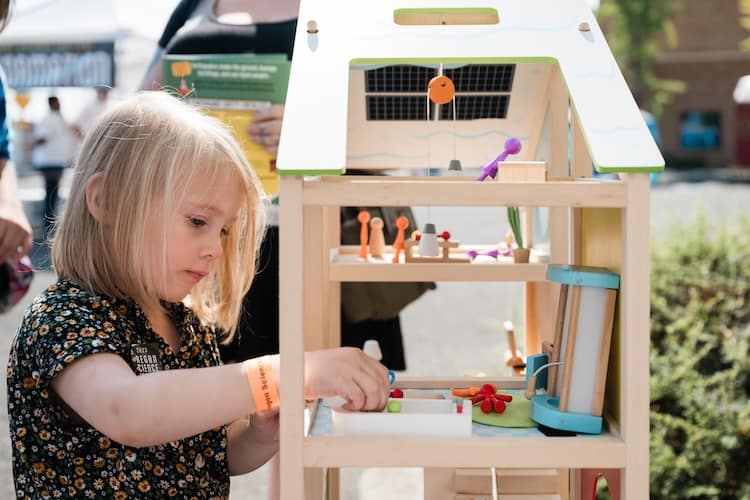
Look out for family preparedness events, particularly The Great Oregon ShakeOut Drill every October, which has several participating institutions, including OMSI. Randol, who leads this initiative at OMSI, says one of the more popular preparedness activities the museum has offered is a dollhouse hazard hunt, where kids arrange furniture and see how it performs during a shake when it’s loose versus anchored (velcroed) to the walls. “The focus is always about preparedness, planning, and practice,” Randol says.
When the Shaking Starts
If you’re outside, stay outside and away from buildings. According to the Oregon Health Authority, the greatest danger from falling debris happens just outside doorways and close to outer walls. Find a place out in the open, away from hazards, and get down low. Stay there until the shaking stops.
If you’re inside, stay inside. Drop first into a crawling position, because the shaking could knock you down into a position that compromises mobility. Take cover under a sturdy table or desk, away from windows. Don’t stand in a doorway — that’s dated advice. According to the Oregon Health Authority, doorways are no stronger than any other part of the house.Hold on to your shelter and be prepared to move with it if the quake shifts its position.
Emergency Kits
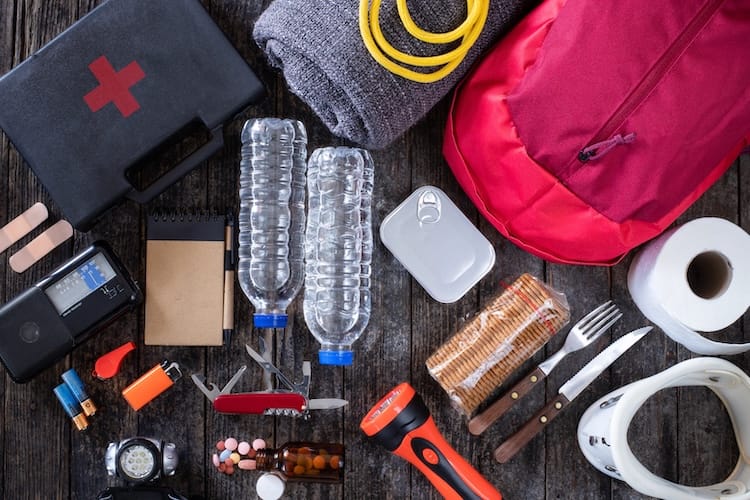
There are plenty of resources that offer a checklist of what should be in your emergency kit. They will include a detailed list of first aid supplies, medicines, sanitation and hygiene supplies, equipment and tools, food and water, clothing and bedding. If your family can afford to set all this aside, wonderful. Do it. And consider the needs specific to your family. Do you need pet food? A life-sustaining medication? Baby formula? Experts recommended having enough supplies to keep your family going for three days.
Don’t forget your child’s needs post-natural disaster. They respond differently than adults. Randol suggests packing a book and/or a stuffed animal in your emergency kit. “Water is important, but so are those comfort items,” he says.
I’m still learning how to be a more useful NET, but practicing with my team has taught me that emergency preparedness is all about putting your body physically through the motions. This not only allows you to fully think through your plan and see what you’re not yet considering, but it builds muscle memory. And there’s something so empowering about trusting that, if disaster hits, you’re not going to panic — you’ll know what to do.
Emergency Kit on a Budget
It can be cost prohibitive to be properly prepared, there’s no denying that. A fully decked out emergency kit can cost hundreds of dollars. Here are some ideas to build your emergency kit for less:
• Print and make copies of important documents for free at the library.
• Buy water and shelf stable foods like peanut butter or protein bars when they are on sale.
• Save free things like plastic utensils or napkins from your take out, or the free toothbrush and toothpaste you get at the dentist. Or ask for items in a Buy Nothing group.
• Pack away your kiddo’s stained clothing to use as their emergency change of clothes.