
“Watch this, Mom!”
Every parent to a risk-taker just held an anticipatory breath reading that.
My 4-year-old says it before he’s about to climb something a little higher than usual, jump a little farther than usual, or, most recently, while scaling a teeter totter past the fulcrum, surfing it as it drops down. And though my body wants to rush over and stop him, I hold my breath, swallow my “Be careful!” warnings, and smile. “Wow!” I say. More often than not, he surprises me and makes his way across the teeter totter unscathed and full of confidence.
Risky play is developmentally normal. It helps kids learn to be aware of their body, what it can do and to recognize risks without fearing them. And it teaches parents to trust their child’s risk assessment, because you’re growing it with them. Hearing my kid ask for help when he’s not fully confident he can make a jump makes me trust him when he leaps from one rock to another. He knows his limits because he is (mostly) free to test them.
So, come prepared with Band-Aids and triple antibiotic ointment, and get out there to figure out what level of risk you’re both comfortable with. Try these places in Portland to practice risky play with your kiddo of any age (OK, maybe not your newborn).
Trampoline Parks
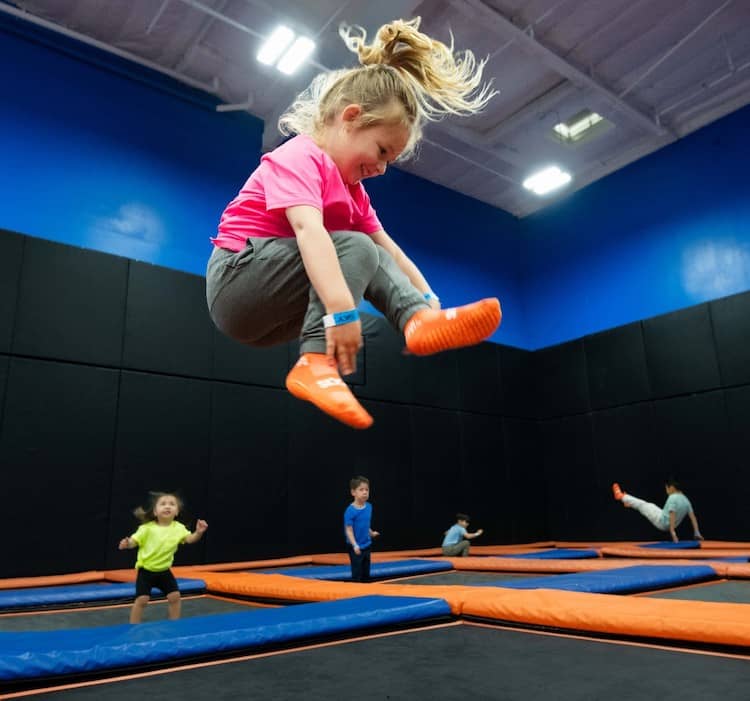
Trampolines are kind of notorious for causing injury, but bouncing is also an amazing outlet for an active child. Part of risky play is understanding the risks. The American Academy of Pediatrics has a whole article about trampoline safety, where they explain the most common ways kids get hurt on trampolines. As their parent, you can help mitigate risks by warning your child about staying away from the springs, hooks or frames, teaching them how to land properly and not letting them be the smallest kid on a crowded jumping surface. Start out cautious and let the risks grow with them at whatever pace works for you both. Try a safety standard-compliant park like Sky Zone Trampoline Park in either Vancouver, Beaverton or Gresham.
Aerial Parks
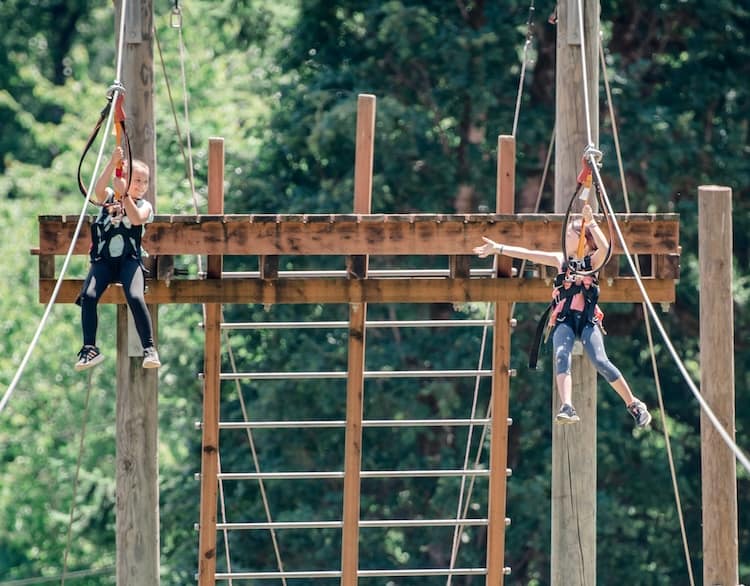
Aerial parks offer a total thrill with significantly less statistical injury than trampoline parks as a whole. At professionally managed aerial parks, your kid is not likely to get hurt unless by human error or faulty equipment. Check for “smart-belay” systems that allow for continuous connection at all times. To the west, try Tree to Tree Aerial Adventure Park in Gaston, which offers an aerial obstacle course with four courses available to ages 7-9, and all six available for ages 10 and up. Plus a mini zipline and park with no safety gear required for ages 2-6 and a zipline canopy tour for big kids and adults. And to the east, there’s Mt. Hood Ski Bowl’s TreeTopZone, for ages 7 and up. [Editor’s note: Stay safe and avoid visiting this area until the fires are out and smoke clears.] Check out more options for aerial parks and ziplines here.
Gyms and Camps
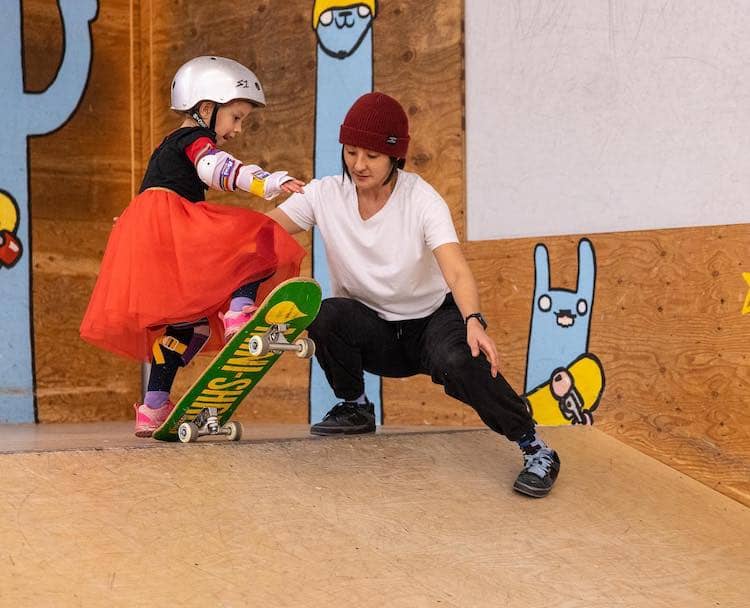
I’m sure you’ve seen Instagram Reels of 3-year-olds dropping in at a vert skate park and thought, “Um, how did they ever find out their baby could do that?” When my little one showed interest in skateboarding, I was at a loss to teach him. I’m no Tony Hawk (heck, I’m not even the tween on the corner who I just saw land a kickflip). Well, it turns out, they have professionals to guide the littlest sports enthusiasts in pretty much anything. I took my kiddo to Stronger Skatepark in Milwaukie, and let their instructor take the reins while he learned on even, well-maintained wooden skate park floors with all the safety padding. Interested in outdoor survival skills? Trackers Earth has a motto: “giving kids knives since 2004.” Take your little climber to any of these rock climbing gyms in Portland or, if they’re more interested in performing tricks, try a space designed for learning with a soft landing like Oregon Gymnastics Academy or a parkour gym like Parkour Visions or Revolution Parkour. Many of these locations offer lessons and summer camps and, most importantly, professional supervision.
Playgrounds and Parks
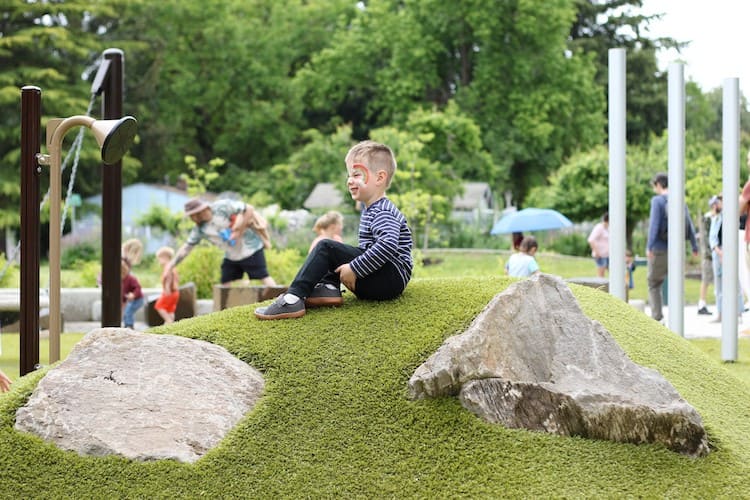
Any park offers risks for a small toddler, but as your kid grows, they may seek out places that meet their skill level. Need some good climbing trees? Try Westmoreland Park, Gabriel Park (between the park and SW Community Center), or Topaz Farm, to name a few spots. Topaz (which requires an admission fee) also offers a playground near the front entrance and the giant tractor combine vehicle is a great spot for risky play. Hoffman Farms’ playground is also constructed from an old tractor, and one of the slides offers a bit of a drop-off kids reach at speed.
The big slide at Errol Heights Park is a self-selecting slide in that it requires some climbing skill to scale the ascending levels of loose-weave netting. My then 3-year-old insisted on trying this slide recently, and I did it with him because he was both afraid and determined. I felt he could easily fall through the netting. We took it slow, obviously frustrating the 7-year-olds who passed us multiple times on the climb up, but man, that look of pride on his face when we got to top was worth it. Kids can go pretty fast down the slide, though it offers a long landing strip at the runout. We went together, and I turned down his request to do it all over again.
One slide he can now handle all by himself (and that I’ve seen scare parents because littles can easily climb the tall stairs to it) is the metal slide at Sellwood Park. This is also where the teeter totter surfing took place, and their off-kilter spinning wheel is another great structure for risky play.
Another organization to be aware of is Portland Free Play, whose programs offer play with loose parts and child-led exploration through pop-up events, camps and support for schoolyard recess through their Play Pod program. Their long-term goal is to open a permanent adventure playground in Portland.
But risky play can and does happen anywhere. Off the armchair, from a tree branch, from the outside of the top level of the would-be “safe” play structure. It’s a practice for both child and parent. I’m working on feeling only appropriately terrified. He’s working on understanding the phrase “too risky.” And in the meantime, I’ll be bringing a rudimentary first-aid kit everywhere we go.